
Temtsel Hao, 4 May 2010
The changing shape of China’s cultural calendar raises sensitive questions of politics, class and ethnicity that its authorities can only evade, says Temtsel Hao.
China’s rapid social transformation is reflected in a different order of priority of the country’s various annual festivals and commemorative days. As the communist state continues to seek tight control over what is permissible, yet as official thinking also adapts to and tries to steer the reclamation of “tradition”, the texture of China’s festive calendar is altering. This change increasingly raises problems for a country and a people caught between the “new” China of the post-1949 period (which is also now “old”) and the “old” China of centuries past (parts of which are again becoming “new”).
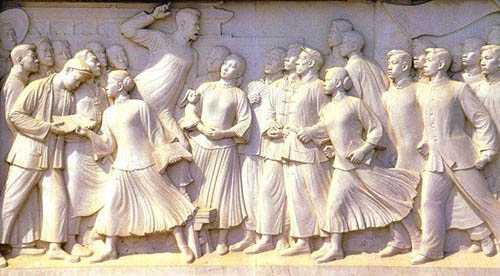
A small example is that the state council of the People’s Republic of China (PRC) stipulates that young people aged between 14 and 28 can enjoy a half-day holiday every 4 May: “youth day”. In practice, few Chinese can afford to leave school or work on this day, which commemorates the momentous student protests against the provisions related to China in the Versailles peace agreement of 1919. Today, the occasion little celebrated; as indeed is another seasonal occasion every 1 May, “labour day”.
It’s true that that labour day (1 May), youth day (4 May) and women’s day (8 March) have been recognised as national holidays since soon after the foundation of the "new China" in 1949. But the political associations of these “new holidays" in a new era of boisterous capitalism mean that the authorities are anxious to downplay them. Alongside them, more traditional Chinese holidays - such as tomb-sweeping day (5 April), the dragon-boat festival and the moon festival (15 August) – have emerged to become more extravagantly celebrated.
The labour question
The state is obliged to go through the motions. China’s president Hu Jintao, on the eve of labour day on 1 May 2010, praised Chinese working people as "the most reliable class basis for the party" and described workers as "the unquestionable leading class of Chinese socialism". An interesting response comes from Ding Xueliang, a sociology professor teaching in Hong Kong. He says that many Chinese working people would be dumbfounded to hear that they are a “leading class”; and that to tell Chinese peasants that the republic is made of a “peasant-worker alliance” (as the state also declares) amounts almost to a political joke.
In the west, “May day” was inspired by the events of 1886 in Chicago and elsewhere in the United States, when a great strike won the right after a hard and bloody struggle to an eight-hour working day. 120 years later, China passed a "labour-contract law" which gives workers rights of guaranteed payment and working-breaks. But in practice, for many Chinese workers - both white- and blue-collar –an eight-hour working day and associated benefits remain a dream (see Kerry Brown, “China: inside strain, outside spleen”, 10 March 2010).
In many western countries there is no official public holiday on 1 May, but it is an occasion when trade unions and leftwing groups march in the streets to affirm working people’s solidarity. By contrast, Ding Xueliang says that the People's Republic of China is one of the few countries in the world where workers are not allowed to celebrate this day on their own initiative.
The memory of youth
The protests of 4 May 1919, provoked by the humiliating treatment of China at Versailles, featured a march by thousands of Beijing students from Tiananmen Square. On the way some of the their number broke in to the home of then treasury minister Cao Rulin – whom they blamed for selling Chinese interests to an encroaching Japan – and burned it down (see Jeffrey N Wasserstrom, “China’s anniversary tempest”, 25 February 2009).
Some revisionist historians in China regard the house-burning affair in 1919 as a stain on the “patriotic” movement. But however the movement is assessed, it is clear that the republican government of the day lacked the kind of powerful police force or anti-riot capacities now possessed by the Communist Party. Even the warlord-politicians who ruled China were not able to impose martial law and use the army to crush students, as happened in Tinanamen Square seventy years later.
The party reveres the 1919 movement as an embodiment of the so-called “May 4 spirit”: a combination of liberty, science and democracy. Its official propaganda sees this spirit as a weapon against imperialism and feudalism, and the movement itself as a pioneer in awakening the Chinese working class to play an important part in Chinese politics.
But "democracy" is nowadays a political taboo in China - and a word to be filtered by the internet-police (see Johnny Ryan & Stefan Halper, “Google vs China: capitalist model, virtual wall”, 22 January 2010). Ding Xueliang says that the scientific aspect of the May movement is acceptable, but the democracy part has since 1989 become a problem for the authorities. The suspicion of democracy makes it very difficult for officials who deal with young people and students to appear logically consistent in their propaganda work.
The traditional revived
Since 2008, other annual occasions - tomb-sweeping day, the dragon-boat festival, the moon festival - have become national holidays in China. The changes to Chinese national holidays in recent years indicate a tendency to neglect – even phase out – those associated since 1949 with class and revolution; and to place more emphasis on those that seem rooted in older Chinese traditions and shared ancestry (especially the imagine common descent of Han Chinese from the emperors Yan and Huang). The influence of overseas Chinese, and those in Hong Kong and Taiwan, has (says Ding Xueliang) played a big part in these revived celebrations.
But to reserve national days for traditional Chinese holidays carries some dangers, and has incurred criticism. Zhang Yiyi, a writer in Hunan province, condemns the conversion of tomb-sweeping day into a national holiday on two grounds: it originates in an imperial ceremony, thus making it a regressive superstition; and it represents the imposition of a Han Chinese holiday upon non-Chinese minorities, thus making it an act of disrespect.
The moon festival, spring festival, tomb-sweeping day and the dragon-boat festival are heralded as the four cardinal Chinese festivals. All of them are now national holidays throughout China, though most are foreign to non-Chinese minority cultures. The moon festival (15 August) is for Chinese a day for family reunion; but it reminds many Mongols of the history of Chinese rebellion against the (Mongolian) Yuan dynasty. Indeed, legend has it that Chinese rebels used moon-cakes to pass a secret massage "to kill Tartars [Mongols] on 15 August".
In China, revolution and class are giving way to capitalism and “tradition”. The most seriously celebrated Chinese national holidays are now all Han Chinese in origin. This brings questions of ethnic sensitivity come into play. True, Han Chinese form the overwhelming majority of the population; and Ding Xueliang says that installing a national holiday with a non-Chinese minority origin would require a very complicated legislative procedure. The Chinese state already has enough problems in adapting the calendar and keeping the people in line.


