Showing posts with label China. Show all posts

Tuesday, 8 May 2012

Imitation Outrage: Faking Concern for the Chinese Masses

Let's stop jacking the Chinese around. We do not care a whit now -- nor have we ever cared -- about their human rights or any other aspect of their lives as long as they satiate our unbridled appetites. To pretend otherwise is to deny centuries of exploitative history in which the West drugged the Middle Kingdom and plundered it for its resources and cheap labor while obliterating any sign of popular resistance to our imperial sway.

 From the Opium Wars to the contemplation of using nuclear weapons to bomb China back to the Stone Age because of our differences with it over Korea and Vietnam, the response of the West has been one of brute intimidation. Never have we been willing to acknowledge that China, for all of its immense contradictions, upheavals, sufferings and errant ways, represents the most complex and impressive example of national history.

Instead we intrude upon China in fitful moments of pique or treat it as a plaything. Who owns China? That was the question that marked the first period of U.S. involvement, when we joined other Western imperialists in carving up China into economic zones. And then came the bitter argument in the U.S. in the late 1940s and the '50s about "Who lost China?" Now Americans find themselves preoccupied with how best to exploit China's amazing economic prowess while feigning interest in the well-being of its people.

Secretary of State Hillary Clinton performed the expected diplomatic dance around the latest flare-up of pretend concern, involving a blind lawyer suddenly made world-famous when he escaped from house arrest in rural China. The fact that Chen Guangcheng was targeted by Chinese authorities because of his opposition to his nation's oppressive population control policies added the United States' "pro-life" lobby to the army of morally subjective China watchers. Now if we can get the pro-lifers to care about the human rights of fetuses after birth, the condition of the millions of severely exploited Chinese workers who float U.S. consumption and our national debt just might stand a chance of improvement.

The overwhelming human rights issue in China is one of labor justice: the right of workers to organize into independent unions and to politically advance their claims on the nation's new treasure, which they have done so much to generate. China has relatively few natural resources other than its people, and its survival as a nation is dependent most of all upon nurturing the well-being of its population. Fortunately that population, ever better educated and more resourceful, has turned out to be the economic salvation of the country rather than the curse that once had been almost universally predicted.

How convenient to forget that concern over China's population bomb began with hysterical warnings from Western alarmists a half century ago when the country's population stood at a mere 400 million. Or to disregard the nation's immense achievement in increasing life expectancy and life quality for a population now more than three times higher. The Chinese also have made giant strides in business, and now when the overlords of Chinese finance attempt to rig international trade in the well-honed practice of the masters of Wall Street, outsiders condemn them for being too effective at the capitalists' game.

Western multinational companies have found advantage in China's population growth by turning many of those additional people into a labor power that now drives the world's economy. While the courage of an activist speaking up against the forced sterilization of women is certainly to be applauded, foreigners' deafening indifference to the working conditions of the millions who make our technologically exquisite toys is a sad commentary on the state of the international human rights movement.

The sanctuary that Chen found in the U.S. Embassy in Beijing was particularly awkward because U.S. Treasury Secretary Timothy Geithner and Clinton were en route to China at the time for urgent meetings on cooperation over security and economic issues. Republicans will attempt to score points by claiming that Chen was pushed out of the embassy to protect the negotiations aimed at getting China to buy more of our bonds. They will be right, but who will they be kidding in suggesting that a Republican president wouldn't have taken the same hard line in dealing with the dissident?

Ever since the Republican Richard Nixon went to Beijing to suck up to Mao Zedong, every American president has acknowledged the power of China's rulers to sweep aside the human rights concerns of foreigners as mere political theater for the folks back home. What a great spin it is to pretend that we are the champions of universal human rights as we tweet about our great concern for the Chinese people on the very mobile devices that their exploited labor created.

We all know that the rulers of China now have the clout to mess up our economy overnight by shedding their holdings in U.S. debt. Our leaders are no more serious about human rights in China than they are about such conditions in oil-rich Saudi Arabia, for the simple reason that we need what those nations have more than they need us.

Author: Robert Scheer Editor, Truthdig.com; Author, 'The Great American Stickup'

Monday, 15 November 2010

Why Vietnam loves and hates China

Why Vietnam loves and hates China
By Andrew Forbes

For more than 2,000 years, Vietnam's development as a nation has been marked by one fixed and immutable factor - the proximity of China. The relationship between the two countries is in many ways a family affair, with all the closeness of shared values and bitterness of close rivalries.

No country in Southeast Asia is culturally closer to China than Vietnam, and no other country in the region has spent so long


fending off Chinese domination, often at a terrible cost in lives, economic development and political compromise.

China has been Vietnam's blessing and Vietnam's curse. It remains an intrusive cultural godfather, the giant to the north that is "always there". Almost a thousand years of Chinese occupation, between the Han conquest of Nam Viet in the 2nd century BC and the reassertion of Vietnamese independence as Dai Viet in AD 967, marked the Vietnamese so deeply that they became, in effect, an outpost of Chinese civilization in Southeast Asia.

While the other countries of Indochina are Theravada Buddhist, sharing cultural links with South Asia, Vietnam derived its predominant religion - a mix of Mahayana Buddhism, Taoism and Confucianism popularly known as tam giao or "Three Religions"- from China. Until the introduction of romanized quoc ngu script in the 17th century, Vietnamese scholars wrote in Chinese characters or in chu nho, a Vietnamese derivative of Chinese characters.

Over the centuries, Vietnam developed as a smaller version of the Middle Kingdom, a centralized, hierarchical state ruled by an all-powerful emperor living in a Forbidden City based on its namesake in Beijing and administered by a highly educated Confucian bureaucracy.

Both countries are deeply conscious of the cultural ties that bind them together, and each is still deeply suspicious of the other. During the long centuries of Chinese occupation, the Vietnamese enthusiastically embraced many aspects of Chinese civilization, while at the same time fighting with an extraordinary vigor to maintain their cultural identity and regain their national independence.

During the Tang Dynasty (6th-9th centuries AD), Vietnamese guerrillas fighting the Chinese sang a martial song that emphasized their separate identity in the clearest of terms:

Fight to keep our hair long,
Fight to keep our teeth black,
Fight to show that the heroic southern country can never be defeated.

For their part, the Chinese recognized the Vietnamese as a kindred people, to be offered the benefits of higher Chinese civilization and, ultimately, the rare privilege of being absorbed into the Chinese polity.

On the other hand, as near family, they were to be punished especially severely if they rejected Chinese standards or rebelled against Chinese control. This was made very clear in a remarkable message sent by the Song Emperor Taizong to King Le Hoan in AD 979, just over a decade after Vietnam first reasserted its independence.

Like a stern headmaster, Taizong appealed to Le Hoan to see reason and return to the Chinese fold: "Although your seas have pearls, we will throw them into the rivers, and though your mountains produce gold, we will throw it into the dust. We do not covet your valuables. You fly and leap like savages, we have horse-drawn carriages. You drink through your noses, we have rice and wine. Let us change your customs. You cut your hair, we wear hats; when you talk, you sound like birds. We have examinations and books. Let us teach you the knowledge of the proper laws ... Do you not want to escape from the savagery of the outer islands and gaze upon the house of civilization? Do you want to discard your garments of leaves and grass and wear flowered robes embroidered with mountains and dragons? Have you understood?"

In fact Le Hoan understood Taizong very well and, like his modern successors, knew exactly what he wanted from China - access to its culture and civilization without coming under its political control or jeopardizing Vietnamese freedom in any way. This attitude infuriated Taizong, as it would generations of Chinese to come.

In 1407, the Ming Empire managed to reassert Chinese control over its stubbornly independent southern neighbor, and Emperor Yongle - no doubt, to his mind, in the best interests of the Vietnamese - imposed a policy of enforced Sinicization. Predictably enough, Vietnam rejected this "kindness" and fought back, expelling the Chinese yet again in 1428.

Yongle was apoplectic when he learned of their rebellion. Vietnam was not just another tributary state, he insisted, but a former province that had once enjoyed the benefits of Chinese civilizationand yet had wantonly rejected this privilege. In view of this close association - Yongle used the term mi mi or "intimately related" - Vietnam's rebellion was particularly heinous and deserved the fiercest of punishments.

China on top
Sometimes a strongly sexual imagery creeps into this "intimate relationship", with Vietnam, the weaker partner, a victim of


Chinese violation. In AD 248, the Vietnamese heroine Lady Triu, who led a popular uprising against the Chinese occupation, proclaimed: "I want to ride the great winds, strike the sharks on the high seas, drive out the invaders, reconquer the nation, burst the bonds of slavery and never bow to become anyone's concubine."

Her defiant choice of words was more than just symbolic. Vietnam has long been a source of women for the Chinese sex trade. In Tang times, the Chinese poet Yuan Chen wrote appreciatively of "slave girls of Viet, sleek, of buttery flesh", while today the booming market for Vietnamese women in Taiwan infuriates and humiliates many Vietnamese men.

It's instructive, then, that in his 1987 novel Fired Gold Vietnamese author Nguyen Huy Thiep writes, "The most significant characteristics of this country are its smallness and weakness. She is like a virgin girl raped by Chinese civilization. The girl concurrently enjoys, despises and is humiliated by the rape."

This Chinese belief that Vietnam is not just another nation, but rather a member of the family - almost Chinese, aware of the blessings of Chinese civilization, but somehow stubbornly refusing, century after century, to become Chinese - has persisted down to the present day.

During the Second Indochina War, Chinese propaganda stressed that Vietnam and China were "as close as the lips and the teeth". After the US defeat, however, Vietnam once again showed its independence, allying itself with the Soviet Union, in 1978-79, invading neighboring Cambodia and overthrowing China's main ally in Southeast Asia, the Khmer Rouge.

Once again Chinese fury knew no bounds, and Beijing determined to teach the "ungrateful" Vietnamese a lesson. Deng Xiaoping, the Chinese leader, openly denounced the Vietnamese as "the hooligans of the East". According to one Thai diplomat: "The moment the topic of Vietnam came up, you could see something change in Deng Xiaoping.

"His hatred was just visceral. He spat forcefully into his spittoon and called the Vietnamese 'dogs'." Acting on Deng's orders, the Chinese army invaded Vietnam in 1979, capturing five northern provincial capitals before systematically demolishing them and withdrawing to China after administering a symbolic "lesson".

But who taught a lesson to whom? Beijing sought to force Hanoi to withdraw its frontline forces from Cambodia, but the Vietnamese didn't engage these forces in the struggle, choosing instead to confront the Chinese with irregulars and provincial militia. Casualties were about equal, and China lost considerable face, as well as international respect, as a result of its invasion.

Over the millennia, actions like this have taught the Vietnamese a recurring lesson about China. It's there, it's big, and it won't go away, so appease it without yielding whenever possible, and fight it with every resource available whenever necessary.

Just as Chinese rulers have seen the Vietnamese as ingrates and hooligans, so the Vietnamese have seen the Chinese as arrogant and aggressive, a power to be emulated at all times, mollified in times of peace, and fiercely resisted in times of war.

In 1946, 1,700 years after Lady Triu's declaration, another great Vietnamese patriot, Ho Chi Minh, warned his Viet Minh colleagues in forceful terms against using Chinese Nationalist troops in the north as a buffer against the return of the French: "You fools! Don't you realize what it means if the Chinese remain? Don't you remember your history?

"The last time the Chinese came, they stayed a thousand years. The French are foreigners. They are weak. Colonialism is dying. The white man is finished in Asia. But if the Chinese stay now, they will never go. As for me, I prefer to sniff French shit for five years than to eat Chinese shit for the rest of my life."

Yet Ho was an ardent admirer of Chinese civilization, fluent in Mandarin, a skilled calligrapher who wrote Chinese poetry, a close friend and colleague of Chinese leaders Mao Zedong and Zhou Enlai. Ho wasn't as much anti-Chinese as he was pro-Vietnamese. It was his deep understanding of and respect for China that enabled him to recognize, clearly and definitively, the menace that "a close family relationship" with the giant to the north posed, and continues to pose, for Vietnam's independence and freedom.

It's ironic, then, that as the current Vietnamese leadership strive to develop their economy along increasingly capitalist lines while at the same time retaining their monopoly on state power, the country they most admire and seek to emulate is, as always, the one they most fear.

Andrew Forbes is editor of CPA Media as well as a correspondent in its Thailand bureau. He has recently completed National Geographic Traveler: Shanghai , and the above is an excerpt from his forthcoming book A Phoenix Reborn: Travels in New Vietnam.

(Copyright 2007 Andrew Forbes.)

Saturday, 29 May 2010

The Sinking of the Cheonan: We Are Being Lied To
by Scott Creighton

There is no doubt about it, there is no longer any reason to hold back, I have looked at the “evidence” and have concluded that we are being lied to, again, by our “leaders” in the White House in order to fabricate a measure of moral justification for yet another “regime change” campaign or an all out war with North Korea.

There simply is no “perfect match” like the recent unsigned report claims there is.

The White House said Monday that President Barack Obama “fully supports” the South Korean president and his response to the torpedo attack by North Korea that sank a South Korean naval ship. MSNBC

South Korea’s president said Monday his nation will no longer tolerate North Korea’s “brutality” and said the regime would pay for a surprise torpedo attack that killed 46 South Korean sailors. ABC News

North Korea has denied responsibility for the sinking of the South Korean warship, the Cheonan, on March 26, which left 46 sailors dead. A growing body of evidence assembled by the South has suggested a North Korean torpedo sank the ship. New York Times

The Growing Body Of Evidence

Clinton told reporters the evidence announced Thursday that North Korea sank the Cheonan “is overwhelming and condemning.”

… Daniel Pinkston, a North Korea expert with the International Crisis Group, a multinational not-for-profit organization, said Friday that evidence that North Korea caused the sinking is “pretty irrefutable.” Stars and Stripes

The International Crisis Group was founded by World Bank Vice-President for External Affairs, Malloch Brown and is funded by other globalist institutions. Their stated mission is to “prevent” international conflict yet somehow or another they always seem to come up with suggestions involving invading other nations or imposing strict sanctions like the kind that killed hundreds of thousands of Iraqi children. Oh yeah, the nations they target usually have a state-owned central bank system… till we invade that is.

So lets take a look at all the “overwhelming” and “irrefutable” evidence. 1. Someone wrote “number 1.” on one single piece of the salvaged torpedo… 2. they claim the torpedo remains are a “perfect match” of a North Korean type of weapon, a “CHT-02D” torpedo. This conclusion was reached via an international research team from US, the UK, Australia, and Sweden. Here is their May 20th, 2010 report. In the report, they make the following conclusion;

The torpedo parts recovered at the site of the explosion by a dredging ship on May 15th, which include the 5×5 bladed contra-rotating propellers, propulsion motor and a steering section, perfectly match the schematics of the CHT-02D torpedo included in introductory brochures provided to foreign countries by North Korea for export purposes. The markings in Hangul, which reads “1번(or No. 1 in English)”, found inside the end of the propulsion section, is consistent with the marking of a previously obtained North Korean torpedo.

… Based on all such relevant facts and classified analysis, we have reached the clear conclusion that ROKS ”Cheonan” was sunk as the result of an external underwater explosion caused by a torpedo made in North Korea. The evidence points overwhelmingly to the conclusion that the torpedo was fired by a North Korean submarine. There is no other plausible explanation. Investigation on the Sinking of the Cheonan

That’s it. That’s all their “evidence” that the international investigators presented in their UNSIGNED report. That’s right, no one knows who the “investigators” were since they didn’t take the time to sign their work.

A Perfect Match?

This is the presentation refered to in the paper linked above. They mention that during a presentation of their findings, they showed the schematics of a CHT-02D torpedo in relation to the evidence they found. They claimed in their investigation that these are a “perfect match” and that claim is being repeated endlessly on both sides of the fake political divide. (please click on image for a larger view)

This is by no means a “perfect match”. No wonder they didn’t want to sign that “investigation” of theirs. (please click on image for a larger view)

There are 4 clear differences in the design of these weapons and one is without a doubt, the key to proving these are not the same.

* “A” & “D” – Here you can clearly see major differences in the design of the hub of the propellers. In the diagram above you can see it has a smaller hub whereas in the evidence below it, the hub is larger.

* “B” – The actual shape of the propellers is very different. You can see a notch in the diagram above that doesn’t exist in the actual evidence propeller below. The overall shape of the blades are vastly different as well, both the front and the rear propeller sets.

All of this might be explained away by suggesting that these propellers were switched out. Thought it might be possible, remember that these are finely tuned and designed systems; one just can’t switch these hub designs “willy nilly” like one would on their John-Boat. But, that aside, though it may be possible to have put different kinds of propellers on this fish, it is certainly NOT a “perfect match”.

Now, the last point proves they are not the same torpedo.

* “C” - As you can plainly see, the stabilizers (or propulsion system?) in the diagram above are clearly shown IN FRONT of the separation plate as it is lined up in the display with the evidence below. However, the torpedo below houses that same stabilizer (or propulsion system) BEHIND the separation plate (separating the body and the tail section of the torpedo).

This is a major difference that cannot be explained by saying it was some kind of after market modification. This is part of a key design of the workings of these weapons and can not have been changed. This difference clearly indicates these are different weapons altogether.

(there are other differences that have been pointed out to this researcher; “Jan” noticed that the axle shape is tapered on the evidence and straight on the diagram. A good point. There are probably others as well (I noticed a difference in the shape of the “fin” in the guidance section in the back as well…. clearly there is no way to say these are a “perfect match”)

It is no wonder the “investigators” chose not to sign their work.

The Forgotten Investigation

On May 6th, 2010 a report came out conducted by South Korea and others that said the torpedo’s metal and explosive residue indicated that it had come from a German origin.

The team of South Korean and foreign investigators found traces of explosives used in torpedoes on several parts of the sunken ship as well as pieces of composite metal used in such weapons, South Korea’s Yonhap news agency said quoting a senior government official.

The metallic debris and chemical residue appear to be consistent with a type of torpedo made in Germany, indicating the North may have been trying to disguise its involvement by avoiding arms made by allies China and Russia, Yonhap quoted the official as saying. REUTERS News Agency

This report has been all but forgotten by the media and the Clinton led state department as they press for crippling sanctions and perhaps more. But there is a confirmation of sorts in the May 20th unsigned “investigation”.

The first thing they should do, rather than attempt to convince the people that the two are “perfectly matched” in design (when they clearly aren’t) is a chemical and metallic debris analysis of the evidence. The May 20th “investigation” does not make mention of this crucial part of the investigation at all… they don’t mention it at all.

The reason for that is clear; if they were to address these two key scientific points, they would have to have admitted that the science shows these pieces of evidence are of German construction and therefore not of North Korean origin.

By ignoring these two important parts of the investigation, the May 20th paper confirms the earlier work of the May 6th study… the torpedo is of German origin.

The “CHT-02D” Torpedo

An earlier report stated that there were only 4 different types of North Korean torpedos that could have caused this damage.

Type EO-6 and ET-80A “Some experts downplayed the possibility of homing torpedoes, citing the low capability of North Korea’s Sang-O (Shark) class submarines.”

Russian Type 53-56

Russian Type 53-59

There had been no mention of the CHT-02D torpedo, and in fact, this researcher can’t find any information on this torpedo aside from links to this story. There is various info on all the other types of North Korean torpedos, but there seems to be none on this one. Why is that? According to the official unsigned report this torpedo is “listed in a brochure” as something North Korea sells, but they do not offer the brochure nor a link to where it can be found. I am still looking for other sources on this matter.

But it appears this weapon came out of no-where.

In a paper I wrote yesterday I questioned whether or not the German-made DM2-A3 looked more like what was found.

The DM2 A-3 version is also used by the Norwegian Ula class (German Type 210 subs) with an option for a later upgrade). The Italian Type 212 B submarines use the DM2 A-4 version. The Israeli Dolphin-class (German Type S-300) are also being equipped with the DM2 A-4 Torpedo.”

It is only a possibility but it is of German design. More investigation into the schematics of this weapon are needed before any conclusion can be reached.

Questions Being Asked

Most MSM and “progressive” parrot websites are running with the “evil North Korea” story without any investigations what-so-ever. But questions are being asked on a few sites.

Democratic Underground has compiled a list of issues surrounding the “official story” and they deserve to be reviewed. They bring up some very good points and I would hope that someone who posts there might provide them with a link to this study of mine. “What if North Korea didn’t fire the torpedo?” Democratic Underground

They bring out many points that I have not addressed here that need to be. One such point is that North Korea vehemently denies the allegations and they have asked to see the evidence inspect it themselves and they have been denied access to it.

Conclusion

It is clear that we are being lied to and manipulated into believing that North Korea is behind the sinking of the South Korean vessel, the Cheonan. It is impossible to draw conclusions at this time as to who is responsible but we can conclude based on the evidence, that the official story is yet another lie being pawned off on the American people. This lie is obvious and could be used to instigate military action against the people of North Korea.

Wednesday, 5 May 2010

China’s seasonal politics


Temtsel Hao, 4 May 2010


The changing shape of China’s cultural calendar raises sensitive questions of politics, class and ethnicity that its authorities can only evade, says Temtsel Hao.

China’s rapid social transformation is reflected in a different order of priority of the country’s various annual festivals and commemorative days. As the communist state continues to seek tight control over what is permissible, yet as official thinking also adapts to and tries to steer the reclamation of “tradition”, the texture of China’s festive calendar is altering. This change increasingly raises problems for a country and a people caught between the “new” China of the post-1949 period (which is also now “old”) and the “old” China of centuries past (parts of which are again becoming “new”).

A small example is that the state council of the People’s Republic of China (PRC) stipulates that young people aged between 14 and 28 can enjoy a half-day holiday every 4 May: “youth day”. In practice, few Chinese can afford to leave school or work on this day, which commemorates the momentous student protests against the provisions related to China in the Versailles peace agreement of 1919. Today, the occasion little celebrated; as indeed is another seasonal occasion every 1 May, “labour day”.

It’s true that that labour day (1 May), youth day (4 May) and women’s day (8 March) have been recognised as national holidays since soon after the foundation of the "new China" in 1949. But the political associations of these “new holidays" in a new era of boisterous capitalism mean that the authorities are anxious to downplay them. Alongside them, more traditional Chinese holidays - such as tomb-sweeping day (5 April), the dragon-boat festival and the moon festival (15 August) – have emerged to become more extravagantly celebrated.

The labour question

The state is obliged to go through the motions. China’s president Hu Jintao, on the eve of labour day on 1 May 2010, praised Chinese working people as "the most reliable class basis for the party" and described workers as "the unquestionable leading class of Chinese socialism". An interesting response comes from Ding Xueliang, a sociology professor teaching in Hong Kong. He says that many Chinese working people would be dumbfounded to hear that they are a “leading class”; and that to tell Chinese peasants that the republic is made of a “peasant-worker alliance” (as the state also declares) amounts almost to a political joke.

In the west, “May day” was inspired by the events of 1886 in Chicago and elsewhere in the United States, when a great strike won the right after a hard and bloody struggle to an eight-hour working day. 120 years later, China passed a "labour-contract law" which gives workers rights of guaranteed payment and working-breaks. But in practice, for many Chinese workers - both white- and blue-collar –an eight-hour working day and associated benefits remain a dream (see Kerry Brown, “China: inside strain, outside spleen”, 10 March 2010).

In many western countries there is no official public holiday on 1 May, but it is an occasion when trade unions and leftwing groups march in the streets to affirm working people’s solidarity. By contrast, Ding Xueliang says that the People's Republic of China is one of the few countries in the world where workers are not allowed to celebrate this day on their own initiative.

The memory of youth

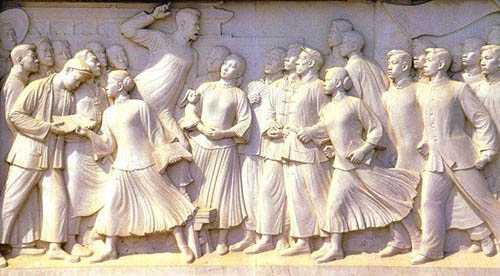
The protests of 4 May 1919, provoked by the humiliating treatment of China at Versailles, featured a march by thousands of Beijing students from Tiananmen Square. On the way some of the their number broke in to the home of then treasury minister Cao Rulin – whom they blamed for selling Chinese interests to an encroaching Japan – and burned it down (see Jeffrey N Wasserstrom, “China’s anniversary tempest”, 25 February 2009).

Some revisionist historians in China regard the house-burning affair in 1919 as a stain on the “patriotic” movement. But however the movement is assessed, it is clear that the republican government of the day lacked the kind of powerful police force or anti-riot capacities now possessed by the Communist Party. Even the warlord-politicians who ruled China were not able to impose martial law and use the army to crush students, as happened in Tinanamen Square seventy years later.

The party reveres the 1919 movement as an embodiment of the so-called “May 4 spirit”: a combination of liberty, science and democracy. Its official propaganda sees this spirit as a weapon against imperialism and feudalism, and the movement itself as a pioneer in awakening the Chinese working class to play an important part in Chinese politics.

But "democracy" is nowadays a political taboo in China - and a word to be filtered by the internet-police (see Johnny Ryan & Stefan Halper, “Google vs China: capitalist model, virtual wall”, 22 January 2010). Ding Xueliang says that the scientific aspect of the May movement is acceptable, but the democracy part has since 1989 become a problem for the authorities. The suspicion of democracy makes it very difficult for officials who deal with young people and students to appear logically consistent in their propaganda work.

The traditional revived

Since 2008, other annual occasions - tomb-sweeping day, the dragon-boat festival, the moon festival - have become national holidays in China. The changes to Chinese national holidays in recent years indicate a tendency to neglect – even phase out – those associated since 1949 with class and revolution; and to place more emphasis on those that seem rooted in older Chinese traditions and shared ancestry (especially the imagine common descent of Han Chinese from the emperors Yan and Huang). The influence of overseas Chinese, and those in Hong Kong and Taiwan, has (says Ding Xueliang) played a big part in these revived celebrations.

But to reserve national days for traditional Chinese holidays carries some dangers, and has incurred criticism. Zhang Yiyi, a writer in Hunan province, condemns the conversion of tomb-sweeping day into a national holiday on two grounds: it originates in an imperial ceremony, thus making it a regressive superstition; and it represents the imposition of a Han Chinese holiday upon non-Chinese minorities, thus making it an act of disrespect.

The moon festival, spring festival, tomb-sweeping day and the dragon-boat festival are heralded as the four cardinal Chinese festivals. All of them are now national holidays throughout China, though most are foreign to non-Chinese minority cultures. The moon festival (15 August) is for Chinese a day for family reunion; but it reminds many Mongols of the history of Chinese rebellion against the (Mongolian) Yuan dynasty. Indeed, legend has it that Chinese rebels used moon-cakes to pass a secret massage "to kill Tartars [Mongols] on 15 August".

In China, revolution and class are giving way to capitalism and “tradition”. The most seriously celebrated Chinese national holidays are now all Han Chinese in origin. This brings questions of ethnic sensitivity come into play. True, Han Chinese form the overwhelming majority of the population; and Ding Xueliang says that installing a national holiday with a non-Chinese minority origin would require a very complicated legislative procedure. The Chinese state already has enough problems in adapting the calendar and keeping the people in line.